
Ontario Rent Increase Rules for 2027
This is general information for people in Ontario. It is not legal advice, and Law HelpLine is not a law firm. Rules and forms change, so check your own situation with a licensed lawyer, a paralegal, or the Landlord and Tenant Board. Last checked against Ontario.ca and Tribunals Ontario on November 9, 2026.
Short answer
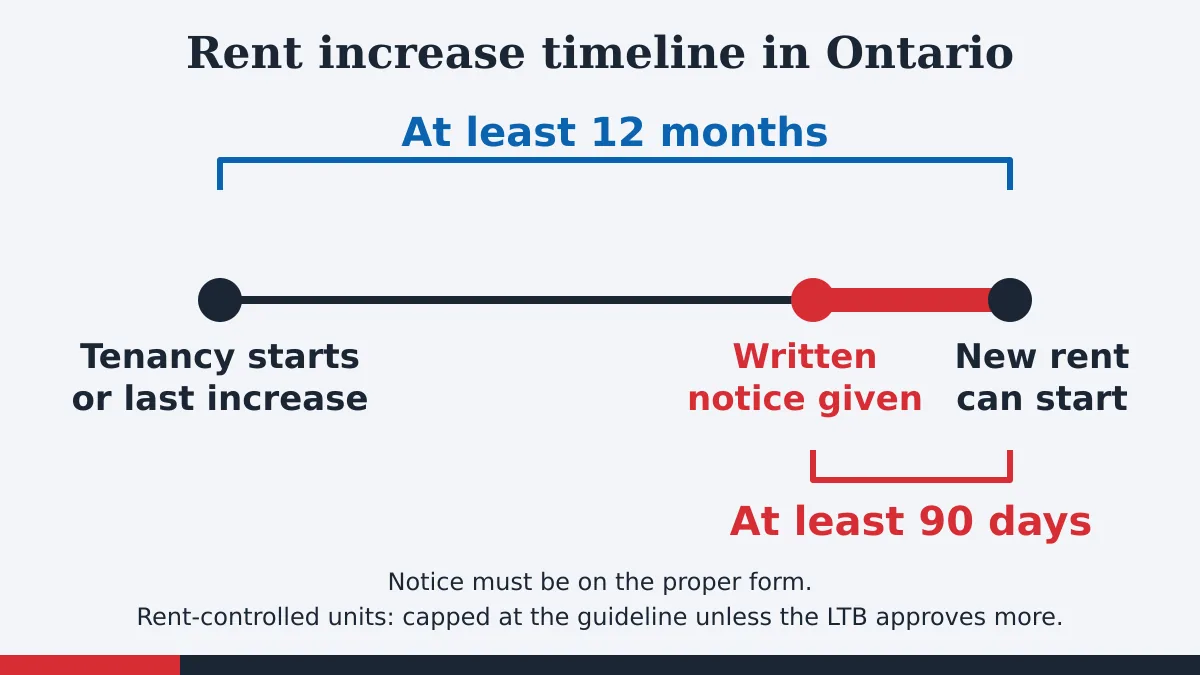
For most Ontario tenants, rent can go up by no more than 1.9% for increases that take effect in 2027. That is the 2027 rent increase guideline. The landlord needs to give written notice in the proper form at least 90 days ahead, and at least 12 months must have passed since the last increase or the start of the tenancy. Some units are not covered by the guideline, and a landlord can ask the Landlord and Tenant Board (LTB) for more.

What is the 2027 guideline?
The guideline is 1.9%, down from 2.1% for 2026. It is the most a landlord can add to most tenants’ rent in a year without LTB approval. Ontario sets it using the provincial Consumer Price Index, with data from June to May, and caps it at 2.5%. A landlord can charge less than the guideline, or nothing.
| Current monthly rent | Maximum 2027 guideline increase (1.9%) | New maximum rent |
|---|---|---|
| $1,000 | $19.00 | $1,019.00 |
| $1,500 | $28.50 | $1,528.50 |
| $2,000 | $38.00 | $2,038.00 |
| $2,500 | $47.50 | $2,547.50 |
The $1,000 example comes from Ontario.ca. The other rows use the same 1.9% calculation.
The three basic rules
- The 12-month rule. In most cases, rent can go up only if at least 12 months have passed since the last increase or since the tenancy began.
- 90 days of written notice. The landlord must give the tenant written notice of the increase, in the proper form, at least 90 days before it takes effect. Ontario’s own example: for an increase on June 1, 2027, the notice has to come at least 90 days before that date. A landlord should count back at least 90 days and allow time for delivery, so it is safest to serve the notice early.
- The right form. Most landlords use the LTB’s Form N1, Notice of Rent Increase. The LTB publishes other versions for special cases, such as units that are partly exempt from rent control and care homes. The notice has to be in writing and on the proper form, so a verbal request does not count.
A rent increase does not happen automatically when the province announces a new guideline. The landlord has to give a valid notice each time.
Which rentals are covered?
The guideline applies to most private rentals under the Residential Tenancies Act, 2006, including houses, apartments, basement apartments, condos, care homes, mobile homes and land lease communities.
Which rentals are not covered?
According to Ontario.ca, the guideline does not apply to:
- new buildings, additions to existing buildings and most new basement apartments first occupied for residential purposes after November 15, 2018
- the starting rent when a new tenant moves in and agrees to the rent with the landlord
- community housing and long-term care homes
- commercial properties
In a care home, the guideline applies to the rent part of the bill, not to services such as nursing, food or cleaning. Social housing is covered by the Act but has different rules for rent control and rent increase notices.
If a landlord says a unit is exempt, Ontario.ca says the landlord is the one who has to prove it. For a new building or addition, that means showing it was first occupied for residential use after November 15, 2018. Records that can help include building permits, occupancy permits and builder documents. Landlords can also state the exemption in the lease. Tenants and landlords can contact the LTB to find out whether a unit is exempt.
Can a landlord ask for more than 1.9%?
Yes, but only with LTB approval. A landlord applies on Form L5 for an above-guideline increase (AGI). The reasons the LTB recognizes are:
- an extraordinary increase in municipal taxes and charges
- eligible capital expenditures, such as major repairs or replacements
- security services costs
For capital expenditures and security services, the LTB says the increase cannot be more than 3% above the guideline in a year. For 2027 that would be up to 4.9% in one year. Any amount over that can be taken in the next two 12-month periods, again up to 3% above the guideline a year. The 3% cap does not apply to extraordinary municipal tax increases. Tenants get a chance to respond at the LTB, and the LTB says it cannot consider the landlord’s or tenants’ financial circumstances or ability to pay.
A landlord and tenant can also agree in writing to an increase above the guideline, on Form N10. The LTB says this kind of agreement is capped at 3% above the guideline, and the tenant has five days after signing to cancel it in writing.
What if the increase looks wrong?
Check these points first:
- Is the notice in writing and on the proper form?
- Does it give at least 90 days before the increase date?
- Has 12 months passed since the last increase or the start of the tenancy?
- Is the new amount within 1.9%, or is it marked as an above-guideline increase that the LTB approved?
- Is the unit actually exempt, or has the landlord only said so?
If the notice is not proper, or you think the rent went up by too much, Ontario.ca says you can dispute it at the LTB within 12 months after the new amount was first charged. Do not wait. Ask the LTB or a legal clinic what you can claim back if an increase was not allowed. Keep copies of your lease, every notice and proof of what you paid.
Tips for landlords
- Track the date of the last increase and the tenancy start date for every unit.
- Use the current LTB form and send it early enough to meet the 90 days.
- Keep records that support any exemption, such as permits and occupancy documents.
- If you want more than the guideline, plan for an LTB application and the paperwork it needs.
Where to get help
The LTB can be reached at 416-645-8080, toll-free at 1-888-332-3234, or by email at ltb@ontario.ca. The LTB forms page and the full Act are on Tribunals Ontario and Ontario’s e-Laws site. For advice on your own situation, speak to a licensed lawyer or paralegal, or a community legal clinic.
Related reading: Real estate legal help in Ontario, Questions to ask at a first meeting with a lawyer, Eviction notices in Ontario: what tenants should know and Legal questions and answers.
Sources
- Tribunals Ontario: LTB forms (N1, N2, N3, N10, L5)
- Residential rent increases, Ontario.ca (updated June 23, 2026)
- Residential Tenancies Act, 2006, e-Laws
- Form N1, Notice of Rent Increase, Tribunals Ontario
- Information about Applications for a Rent Increase Above the Guideline, Tribunals Ontario
- A Guide to the Residential Tenancies Act, Tribunals Ontario